Seagrass adds 36% to mangrove soil, slowing Biscayne Bay sea-level rise
A new study reveals that drifting seagrass is a major component of the soil building beneath Biscayne Bay mangroves, helping the forest keep pace with rising tides.
By Zara Ahmed ·
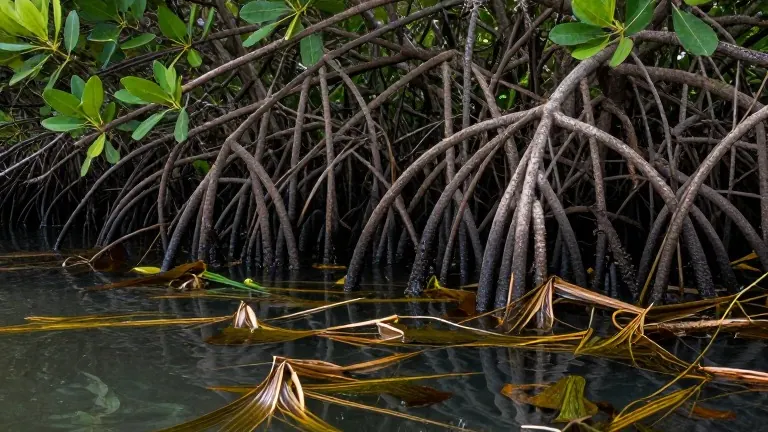
Between 36% and 53% of the carbon near the surface of Biscayne Bay mangrove soil comes from seagrass, according to a study published in the journal Estuaries and Coasts. This finding challenges the long-held belief that mangroves build their own ground exclusively from their leaves, wood, and roots.
Researchers from Florida International University and the National Park Service determined that this offshore contribution is vital for the forest's survival. The soil beneath the mangroves is currently rising at a rate of 2 to 4 millimeters per year. In contrast, sea levels in the region are rising by 8.5 millimeters per year. The study shows that while seagrass alone cannot close this gap, it significantly increases the volume of material available for the forest to retain.
The accumulation of this material occurs through a process of natural drift. Dead seagrass blades and seaweed break loose and float until the tide carries them into the mangrove forest. Once inside, these organic materials pile up and decompose slowly. This slow breakdown allows more matter to remain in the ground over time, adding to the forest floor in a way that native mangrove debris does not.
Kevin Montenegro, a biology Ph.D. student at FIU, conducted the fieldwork for this research. For two years, he loaded a 16-foot canoe onto a truck before sunrise each month. He paddled for an hour into Biscayne National Park to wade into the mangroves and observe the incoming debris. He and a field partner worked at two sites within the park, recording the location and depth of the washed-in material at specific points moving inland from the shoreline.
The team also collected soil samples for chemical analysis and monitored the decomposition rates of mangrove leaves and seagrass. They placed mesh bags containing these materials on the swamp floor to measure how quickly they broke down. The researchers combined these observations with elevation data that the National Park Service has collected at the same locations since 2011.
The results varied by location. The highest share of seagrass-derived carbon was found in wetlands around Cutler Bay. In this area, more than three times as much debris reached the inner forest compared to the primary study site. This site also recorded the fastest rate of ground elevation increase. The mesh bag data indicated that where more debris accumulated, the seagrass decomposed more slowly, leaving more material behind to build the soil.
Montenegro, who graduated with his Ph.D. earlier this year, now works in the Department of Environmental Resources Management for Miami-Dade County. He noted that seagrass ecosystems are highly sensitive to water quality. If these offshore meadows decline due to poor water conditions, the mangroves lose a key source of resilience and blue carbon storage.
The study highlights the interconnected nature of these ecosystems. Montenegro stated that what harms the seagrass offshore eventually reaches the mangroves onshore. The research was conducted as part of FIU’s CREST Center for Aquatic Chemistry and Environment. Montenegro was also a 2022 FIU Everglades Scholar, a program supported by the Everglades Foundation.
Source: FIU News · original report published