
Nearly complete radar complex in Kaliningrad can scan 3,000 kilometers into Europe
Lithuanian defense officials say the structure near Gvardeysk will allow Moscow to detect aircraft and missiles across the continent.
By Miguel Navarro ·
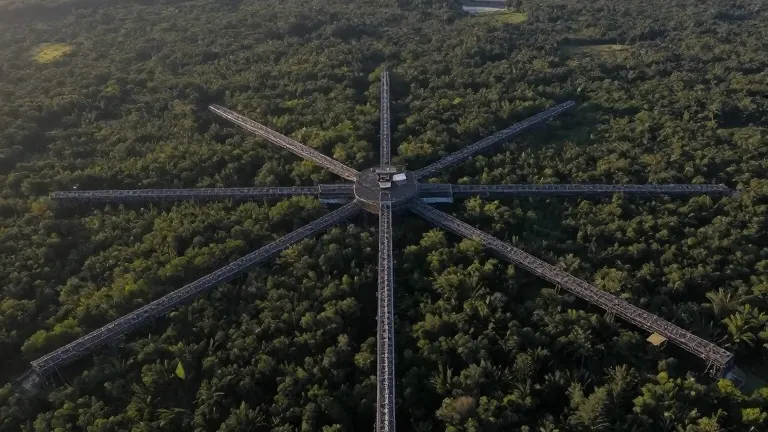
Construction of a massive radar installation in Russia's Kaliningrad exclave is nearing completion, positioning the Kremlin to monitor military activity across much of Europe. The facility, located near the town of Gvardeysk, features three radiating arms that each extend more than 500 meters. Satellite imagery depicts the structure as a sprawling complex set within a forested nature reserve, resembling a large landing platform.
Vaidotas Malinionis, a retired Lithuanian commander, stated that the over-the-horizon radar will possess a surveillance range of approximately 3,000 kilometers. This distance allows the system to peer beyond the curvature of the Earth, covering almost every corner of Europe and extending deep into Ukraine. Malinionis noted that the system is designed for early warning capabilities and the observation of long-distance targets.
Reports from The Times, citing data from the Finnish-Polish defense firm ICEYE, indicate the system is also intended for the detection and jamming of electronic signals. Malinionis explained that the radar could intercept satellite communications and track aircraft movements and ballistic missiles. He added that the system could provide NATO with less time for decision-making if Russian forces were to invade the alliance's eastern frontier.
Latvian geopolitical analyst Evija Djatkovica warned that the new technology addresses a specific gap in current defense networks. She stated that the radar will help Russia detect low-flying objects, reducing the effectiveness of drones in regional defense doctrines. Djatkovica described the development as part of a broader effort to turn Kaliningrad into a hub for advanced military sensors and electronic warfare.
The Kaliningrad region, situated on the Baltic Sea between Poland and Lithuania, is already a focus of military tension. Russia has previously told NATO it is prepared to use nuclear weapons if the alliance attempts to blockade the exclave. Malinionis cited sources suggesting that up to 100 nuclear warheads are capable of being deployed in the area, though he noted this figure remains unconfirmed.
ICEYE has also identified a second large circular antenna complex approximately 50 kilometers west of Gvardeysk, near Chernyakhovsk. More than 20 signal and electronic warfare facilities are reportedly located throughout the region. Satellite images further show new shelters for fighter jets at the Kaliningrad-Chkalovsk airfield and launch pads at a mobile S-400 missile site in Baltiysk.
European nations are adapting their own defenses in response. Poland is converting offshore wind farm infrastructure in the Baltic Sea into NATO surveillance assets. Additionally, the German arms manufacturer Rheinmetall is building Synthetic Aperture Radar satellites with ICEYE. The first of these satellites, which can image troop movements in any weather, are scheduled for launch on a SpaceX rocket in early 2027 for use by the Bundeswehr brigade in Lithuania.
Source: Deutsche Welle