Midterm polls: Democrats likely to win House, Senate outcome unclear
Final surveys show a Democratic advantage in congressional races, but margins in key Senate states remain within error, complicating predictions for Senate control.
By Dylan Moore ·
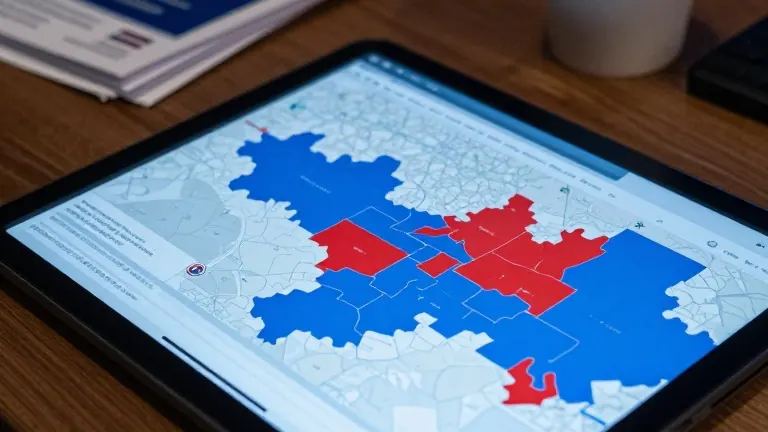
Polling data released in the days before the midterm elections indicates a strong likelihood that Democrats will capture the U.S. House of Representatives, while the outcome for the Senate remains statistically contested. The final wave of surveys shows consistent Democratic leads in generic congressional voting, yet the magnitude of that lead varies significantly across individual Senate races.
Democratic candidates currently lead the generic congressional ballot by eight points. This margin is supported by a review of the 50 most recent polls, all of which show Democrats ahead. The lead began to widen in September as voter attention shifted toward the midterms. This level of support aligns with polling levels from this point in the 2018 cycle, a year when Democrats won 41 House seats.
President Donald Trump’s low approval rating appears to be a factor in these results. Recent CNN polling places his approval at 32 percent, a figure seven points lower than his standing during the 2018 midterms. Other polls show slightly higher numbers, with an average approval rating of 38 percent. Political analysts suggest this average could negatively impact Republican candidates running nationwide.
The Cook Political Report has updated its forecasts to reflect these shifts. The firm rates Democrats as favorites in 220 House seats, which is two seats more than the majority needed for control. The report projects that Democrats will flip between 12 and 22 seats, a margin that would result in a comfortable majority for the party in the lower chamber.
The Senate race presents a different picture. Democrats need to gain a net of four seats to secure control. Currently, Democratic candidates are statistically tied or leading in eight seats held by Republicans: South Carolina, Alaska, Maine, Kansas, Texas, Iowa, Ohio, and North Carolina. They also lead in Michigan, a seat held by a retiring Democrat. However, with the exception of North Carolina, all of these races fall within the margin of error.
Republicans argue that their voter base will turn out in higher numbers on election day than polls suggest, a trend that could preserve GOP control of the Senate. Nate Silver’s analysis notes that in the last three presidential elections, final polling averages underestimated Republican support by an average of 3.8 points. This discrepancy would be large enough to swing most of the close Senate races. However, midterm elections have shown a different pattern since 2016, with polls overstating Republican support by a mere 0.2 percent.
Patrick Ruffini, a Republican pollster, noted that polls at this stage of the cycle from 2018 to 2024 overestimated Democratic support by 6.2 points in specific states, including Iowa, Michigan, and Ohio. This data suggests that if Republican hopes rely on the belief that polls are drastically missing their voters, they may be overstating the potential impact of that gap on Tuesday’s results.
Undecided voters, particularly Republicans in red states, represent a final variable. CNN polling found that in Texas and Kansas, at least six in 10 undecided voters are Republicans or lean Republican. This suggests room for political momentum to favor the GOP, which could slightly hinder Democratic efforts to take the Senate. However, the path to a Democratic win remains open given the current polling numbers.
Early voting data offers additional insight into voter behavior. As of Thursday, over 42 million early ballots have been cast, a pace similar to 2022 and higher than the 39 million total votes from 2018. In states reporting partisan breakdowns, Democrats account for 44 percent of early voters, Republicans for 31 percent, and Independents for 25 percent. In Maine, Democrats outnumber Republicans in the early vote by more than two to one, with 48 percent supporting Democrats compared to 22 percent for Republicans.
In Iowa, Democrats lead the early vote by 15 points, with 48 percent support against 33 percent for Republicans. In Kansas, the race is closer, with Democrats at 45 percent and Republicans at 41 percent. In Michigan, where Democratic candidate El-Sayed needs to win young voters, those under 40 make up only 14 percent of the early vote. This is roughly half of what polls estimate. Republican Mike Rogers holds a wide lead among voters over 45, with 55 percent support compared to 43 percent for El-Sayed. If young voters do not show up in large numbers, Rogers has a better chance of winning than current polls indicate.
Source: Pasadena Star-News