87%: The number behind Michigan's Black-Jewish voting push
A DC-based nonprofit is using billboards and yard signs to target Black voters in Detroit-area cities, aiming to secure support for the pro-Israel stance of Republican Senate candidate Mike Rogers.
By Dylan Moore ·
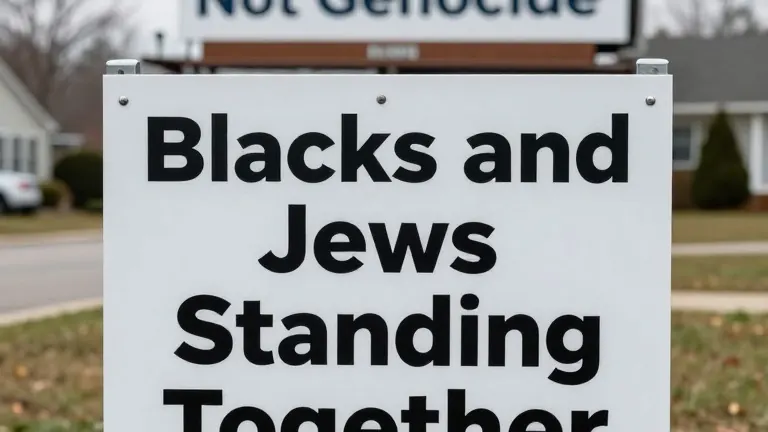
A Washington, DC-based nonprofit is spending money on billboards and yard signs in Michigan to tell Black voters to stand with Israel and Jewish communities. The group, the Center for Urban Renewal and Education, or CURE, launched this campaign in the final days before the state's U.S. Senate election. The effort targets cities with large Black populations, including Detroit, Flint, and Ypsilanti.
CURE director Star Parker said the goal is to remind Black Christian voters of reasons to support Israel. The yard signs read “Blacks and Jews Standing Together.” Billboards in the area display messages such as “Self Defense is Not Genocide” and “Many Black Evangelicals Agree that Israel Has a Right to Exist.” None of the signs name a specific candidate, but they align with the pro-Israel position of Republican nominee Mike Rogers.
The timing of the campaign is strategic because the Democratic nominee, Abdul El-Sayed, has faced challenges in uniting two key voting blocs. El-Sayed has alienated some Jewish voters with his rhetoric on Israel and Jewish safety. He has also struggled to consolidate traditional Black support, although that gap has narrowed recently. A poll commissioned by the Detroit News indicates that 87 percent of likely Black voters now support El-Sayed.
Despite the polling numbers, tensions persist between Black and Arab communities in the Detroit area. Sam Robinson, a reporter for a historic Black newspaper in Detroit, noted a “scarcity mindset” among some voters. He said some believe there are limited resources and that Arab communities are taking a share of what belongs to Black people. This sentiment appears in local political ads and community discussions.
Rogers has actively courted both Black and Jewish voters. A super PAC linked to Rogers has spent heavily on advertisements claiming El-Sayed has been “disrespectful and dishonest with Black voters.” These ads often highlight tensions between local Black and Arab communities. CURE’s signs appeared in the final week of the campaign, following an October 22 interfaith roundtable in Detroit hosted by the organization.
The roundtable featured a local rabbi and Black pastors discussing the history of Black-Jewish organizing. Rabbi Aaron Bergman of Adat Shalom, a Conservative synagogue in Farmington Hills, participated in the event. He said via email that politics was not the primary focus. “It was mostly about teaching about antisemitism, which I guess at this point in history is political,” Bergman wrote.
El-Sayed has focused his campaign’s final stretch on driving turnout among Black voters. He has visited Black churches and held events with former President Barack Obama and Representative Jim Clyburn of South Carolina. Driving up participation in Black communities is viewed as key to El-Sayed’s chances of winning the seat.
A wildcard in the race is the last-minute endorsement of Rogers by Pro-Israel Democratic Representative Haley Stevens. Star Parker of CURE said she believes many Black Christian voters will follow Stevens’ lead. “Their support for Israel needed a boost,” Parker said. “I believe this endorsement has taken Mike Rogers over the finish line with Black voters.”
Some evidence suggests Palestinian rights may be a more animating issue for Michigan’s Black voters this year than in the past. Pro-Palestinian state Representative Donavan McKinney won his primary challenge against a pro-Israel incumbent in a majority-Black district in August. During a campaign stop in Detroit, a Black community organizer confronted Stevens directly over her support for Israel.
The CURE campaign represents a direct intervention in the local religious and political dialogue. The group is using visible signage to reinforce a specific message in the days before voters head to the polls. The race remains competitive, with both sides targeting specific demographic groups to secure their base.
Source: The Times of Israel